
REVIEW · SIGHTSEEING CRUISES
Malta: City Sightseeing HOHO Bus Tour & Optional Boat Tour
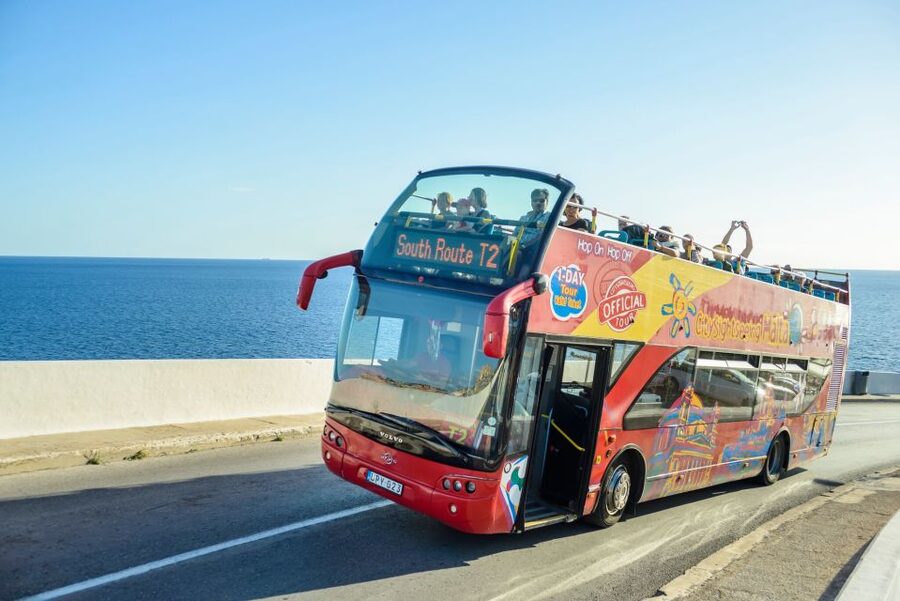
Malta reveals itself in layers. This open-top bus tour links Mdina and the Three Cities with fishing villages, temples, churches, and sea views that are hard to cover by public transport in one outing. I like the broad coverage and the freedom to hop off at places such as Marsaxlokk, Mosta, and the Blue Grotto. The main catch is timing: the routes are long, buses can run late, and you will need two days to explore without rushing.
I also like the optional harbor cruise, which gives your legs a rest while showing Valletta, Sliema, and the surrounding harbors from the water. The recorded commentary is offered in many languages, but it can be brief, out of sync, or affected by faulty headphone ports. Bring sunscreen for the upper deck and check your route before boarding.
Key points to know before boarding
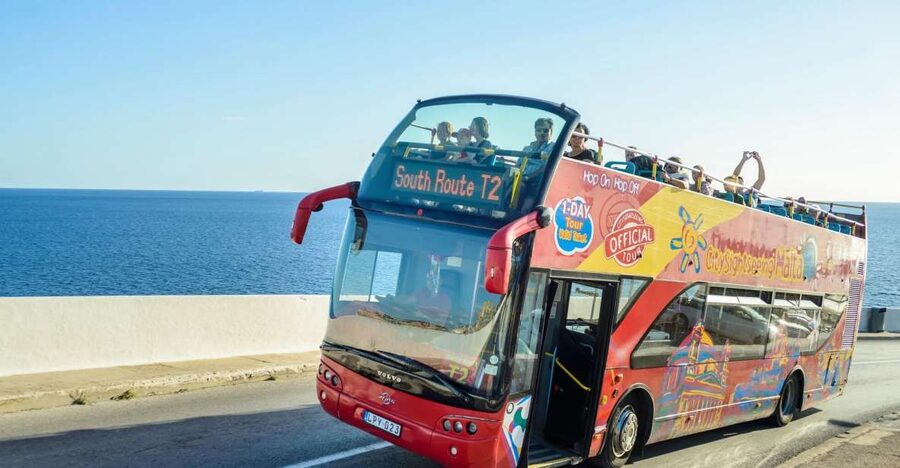
- Two long routes cover much of Malta: The North Route takes about 210 minutes, while the South Route takes about 180 minutes without hopping off.
- Mdina is the strongest North Route stop: Its medieval streets and nearby Roman sites make it worth leaving the bus.
- The South Route has the bigger sightseeing payoff: Marsaxlokk, the Three Cities, Tarxien Temples, Hagar Qim, Mnajdra, and Blue Grotto all appear on this circuit.
- A two-day ticket is the sensible choice: One day rarely gives you enough time for both routes and meaningful stops.
- The harbor cruise is a useful add-on: It can be used on a separate day, depending on the ticket option, and pairs well with a slower day in Valletta.
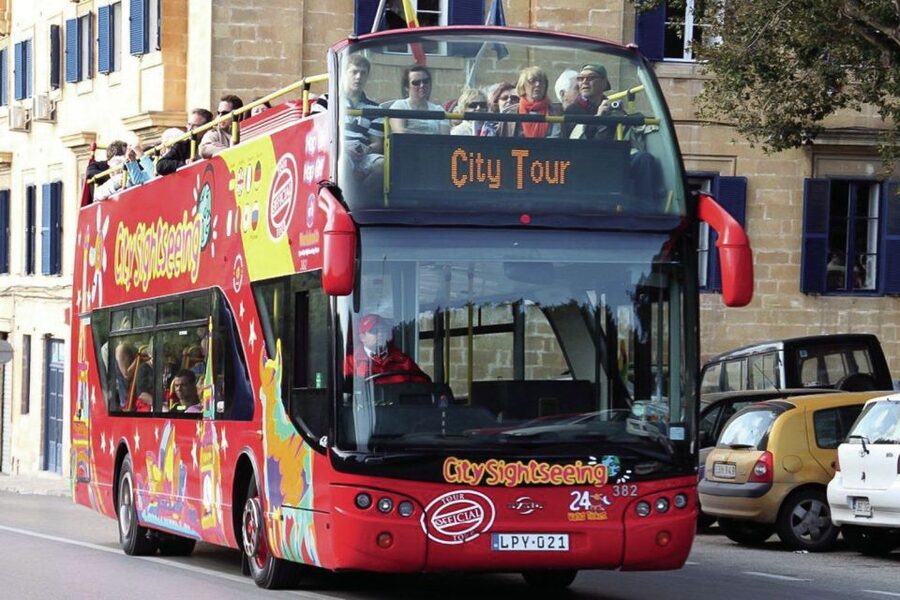
- The bus is practical, not luxurious: Some seats are hard, some headphone sockets may not work, and stop signs can be unclear.
What this Malta bus tour actually covers
This is not just a quick circuit around Valletta. The two routes reach Malta’s northern coast, central towns, southern temples, old fortified settlements, and small fishing communities.
The bus runs during the warmer season from May onward, with the North and South routes operating daily. The North Route takes about three and a half hours for the full circuit. The South Route takes about three hours. Those times sound manageable, but they do not include the time needed to get off, visit a site, eat lunch, or wait for the next bus.
That distinction matters. If you stay on board, you can see a great deal of Malta in one day. If you want to visit Mdina, walk around Marsaxlokk, or enter the temples and catacombs, plan on two days.
The tour uses open-top buses, so you get clear views from the upper deck. That is excellent for Malta’s coast and old stone towns, but the sun is strong. Take sunscreen, water, and something to protect yourself from wind or sudden rain. After wet weather, upper-deck seats may still hold water, so look before sitting.
More Sightseeing Cruises in Malta:
- Budapest: City Highlights Sightseeing Cruise
★ 4.6 · 43,981 reviews - Prague: 50-Minute Sightseeing Evening Cruise
★ 4.2 · 33,780 reviews - Budapest: Nighttime or Daytime Sightseeing Cruise
★ 4.2 · 21,062 reviews
Starting in Bugibba, Qawra, and St Julian’s
The North Route begins around Bugibba and Qawra, then runs south through St Julian’s and Sliema toward Valletta. This makes the tour useful if you are staying in Malta’s northern resort areas rather than in the capital.
Stops include the Bugibba waterfront, the Malta National Aquarium, Qawra Seafront, Mediterraneo Marine Park, and the area around St George’s Bay. In St Julian’s, the bus serves points near the Westin Dragonara, Hilton, Spinola Bay, and Balluta Bay.
These early stops are mainly useful for orientation and transport. If you are staying nearby, you can board without making your way to Valletta first. If you are staying elsewhere, Valletta is usually the clearest place to begin because it connects both routes and the harbor cruise.
The timetable is important. North Route departures from the first listed stop are at 8:00, 9:00, 10:00, 11:00, 11:30, 12:30, 1:30, and 2:30. The service does not operate like a city bus that runs every few minutes. Miss one, and your carefully planned stop may become a long wait.
Valletta, Sliema, and changing routes
Sliema Ferries is Stop 17 and one of the voucher redemption points for mobile tickets. Valletta Waterfront Terminus is Stop 20 and the other mobile voucher exchange point. Paper vouchers can be redeemed at any bus stop.
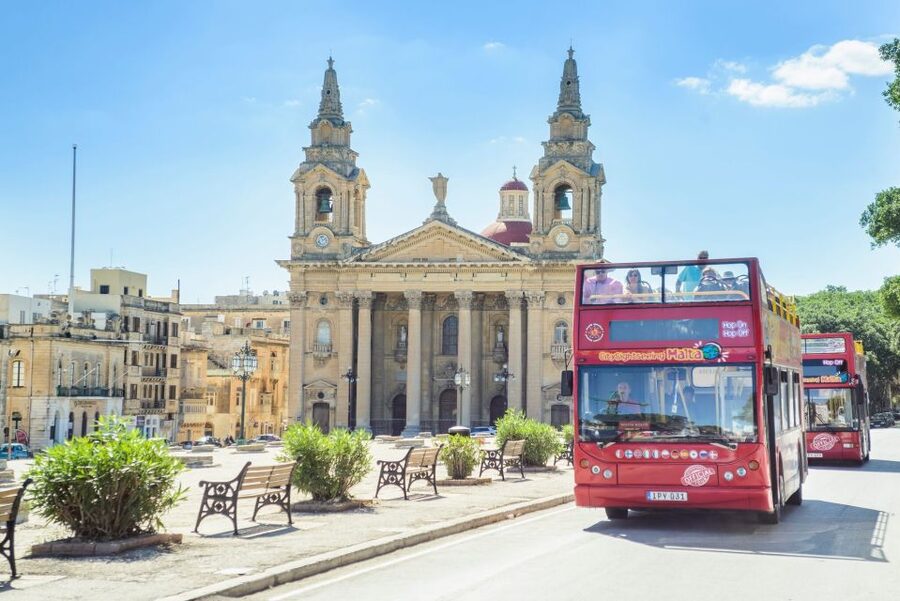
This is worth sorting out before you arrive. There are several sightseeing operators in Malta, and the buses and stops can look similar. Company signs are not always clear, especially in Valletta, so check that you are boarding the City Sightseeing bus covered by your ticket.
Valletta City Center and Valletta Waterfront are the key connection points. The Waterfront Terminus is where you change between the North and South routes. The route also serves the Valletta area near the Malta Experience, the Knights Hospitaller War Museum, and Fort St Elmo.
You can use the bus as a sightseeing ride, but you can also treat it as a rough transport link. The trouble is that traffic, roadworks, narrow streets, and delayed buses can affect the day. Do not plan a tight connection between your final bus stop and a cruise departure.
The South Route: temples, harbors, and the Blue Grotto
The South Route is the more rewarding circuit if ancient sites and coastal views interest you. It leaves the Valletta and St Julian’s area, then heads toward Tarxien, the Three Cities, Marsaxlokk, Birzebbugia, the Blue Grotto, and the prehistoric temples.
The first major stop is Tarxien Temples, built around 3000 BC. The site gives Malta an important prehistoric layer that is easy to miss if you spend all your time in Valletta and Mdina. Entry is not included, so check the opening details separately before planning a long stop.
Next comes the Vittoriosa Waterfront in the Three Cities area. Vittoriosa, also known as Birgu, is part of Malta’s fortified harbor district along with Senglea and Cospicua. The bus gives you a useful overview, but you will need to hop off and walk if you want more than a passing look.
Marsaxlokk is one of the best places to leave the bus. This traditional fishing village is known for its harbor setting and local character. The stop works well for a meal or a walk, but allow enough time to catch the next bus. Since the routes are not especially frequent, a relaxed lunch can turn into a missed departure.
Pretty Bay in Birzebbugia follows, then the Blue Grotto. The Blue Grotto stop offers dramatic coastal views and access to boat trips into the caves, but the cave entry or boat ride is not included in this ticket. The bus simply gets you to the area. You will need to pay separately if you choose to visit by boat.
The route then reaches Hagar Qim and Mnajdra, two important prehistoric temple sites. These are among the strongest stops on the full tour, especially if you want to understand Malta beyond its later medieval and British-era sights. Again, attraction admission is separate.
South Route departures from its first listed stop are scheduled at 9:05, 10:05, 11:05, 12:05, 1:05, and 2:05. The last departures and connections can be affected by traffic, so do not leave the most important stop until late in the day.
A few more days afloat around Malta worth a look
- Sliema: Cruise to Comino, Crystal Lagoon, and Blue Lagoon
★ 4.5 · 6,855 reviews - Malta: Gozo, Comino & Blue Lagoon Cruise – swim & sightsee
★ 4.7 · 6,564 reviews - Malta: Blue Lagoon, Beaches & Bays Trip by Catamaran
★ 4.7 · 5,496 reviews - From Malta: Full-Day Gozo UTV Tour with Lunch and Boat Ride
★ 4.6 · 4,408 reviews
Marsaxlokk and the Three Cities deserve time
The bus is at its best when it gets you close to a place that would otherwise require several transport changes. Marsaxlokk is a good example. You can see the village quickly from the bus, but its value comes from getting off, walking by the water, and taking a slower look at the boats and harbor.
The Three Cities are different. They are less about one famous sight and more about the setting, fortifications, waterfront, and older streets. A bus circuit gives you the broad view, while a separate walk lets you understand how the harbor settlements fit together.
If you only have one day, choose carefully. Trying to visit Marsaxlokk, Tarxien, the Blue Grotto, and both temple sites in the same day may leave you watching the clock more than enjoying Malta. The South Route is better treated as a full day with one or two major stops.
The North Route: Mosta, Rabat, Mdina, and Golden Bay
After Valletta, the North Route turns inland. It passes San Anton Gardens and Ta’ Qali Craft Village, then reaches the aviation museum and Mosta Church.
Mosta Church is known for its enormous dome, one of the route’s most recognizable sights. The stop is convenient because you can see a major landmark without arranging a separate trip across central Malta. Ta’ Qali adds a craft and local-products angle, while the aviation museum offers a different kind of stop for visitors interested in Malta’s more recent past.
The route then reaches Mdina Main Gate and Rabat. This is where I would spend serious time. Mdina, the old fortified city, is compact enough to explore on foot and atmospheric enough to reward a slow walk. Its stone lanes, high walls, and hilltop setting make it one of Malta’s essential stops.
Nearby Rabat adds the Domus Romana, St Agatha’s Catacombs, and other Roman-era sites. These attractions are separate from the bus ticket, but the route places them close together. You can choose one or two instead of trying to see everything.
Golden Bay appears on the way back toward the northern coast. It provides a change from old stone towns and archaeological sites, with open coastal views and a more relaxed seaside feel. The tour does not stop at every popular attraction in the north. Popeye Village and the Falconry Centre, for example, are not listed stops, so check the route before assuming a particular sight is included.
Why Mdina is the best North Route stop
Mdina is the stop most likely to make the long North Route worthwhile. The bus gets you near the main gate, but the real experience begins after you leave the road behind.
Allow enough time to walk without a rigid checklist. The town is not large, but its appeal comes from the stone streets, quiet corners, viewpoints, and sense of enclosure. Rabat is close enough to combine with Mdina if you have the time and energy.
The practical problem is that Mdina can absorb more time than expected. If you spend the morning there, you may not have enough time for Mosta, Ta’ Qali, Rabat, and Golden Bay before the final buses. That is not a flaw in Mdina. It is a reminder that the bus is a framework for visiting Malta, not a guarantee that every stop can be explored in one day.
The harbor cruise adds a different view
The optional cruise is a strong addition, especially after a full day on the bus. It shows Malta from the water and gives you views of the harbors around Valletta and Sliema that you cannot get from the road.
The cruise departs from the Sliema Ferries area, which is also a bus stop. The boat portion is not simply another version of the bus ride. It changes the scale of the trip, showing the fortified waterfront and harbor entrances from outside the city streets.
The timing rules depend on the ticket. With the one-day bus and cruise option, the bus ticket is valid for one day, while the harbor cruise can be used within three days of activation. With the two-day option, the bus can be used over two days, not necessarily consecutive days, and the cruise can be used within five days of voucher activation.
That flexibility is valuable. A sensible plan is to use one day for the North Route, one day for the South Route, and the cruise on a separate day. You avoid trying to race from a delayed bus to a boat departure, a problem that can easily spoil an otherwise good day.
Audio commentary, seats, and comfort
The driver speaks English, while the recorded guide is offered in English, Spanish, Dutch, French, German, Italian, Maltese, Russian, Japanese, Chinese, Portuguese, Polish, Danish, and Finnish.
The commentary helps explain what you are passing, but do not expect a full guided tour at every stop. Some sections have limited information, and audio outlets or headphones may not work properly. In a few cases, sound volume has been too low or the recording has not matched the sight outside.
Bring the supplied headphones, but keep your own expectations modest. A printed route map or a screenshot of the stops is useful, especially because some pickup points are poorly marked and drivers may not always announce every stop clearly.
The upper deck gives the best views, but the seats are basic and can become uncomfortable on a three-hour circuit. Air conditioning may not feel strong enough in hot weather. The lower deck is less scenic but can be the better choice when the sun is intense or the upper seats are wet.
Price and value at about $33
At about $33 per person, the basic ticket is good value if you use it for transportation and sightseeing over a full day. Malta has many widely scattered sights, and the bus removes much of the need to arrange separate rides.
The value improves sharply with the two-day option. You get time for both routes, and you can use the cruise on another day if you select the combined ticket. The one-day ticket makes more sense for a short visit when you mainly want an overview.
The price does not cover admission to Blue Grotto cave trips, temples, catacombs, museums, food, or drinks. Add those costs before deciding how many stops to make. The bus gets you near the sights, but it is not an all-inclusive attraction pass.
How I would plan the tour
For a two-day visit, I would use the South Route first if ancient temples and coastal scenery are your priorities. Get off at Marsaxlokk or the Blue Grotto area, then choose either the temple sites or the Three Cities rather than trying to do every stop.
On the second day, take the North Route early. Make Mdina your main stop, then add Mosta or Rabat if the timetable allows. If you buy the cruise option, use it on a separate day or after a lighter schedule in Valletta.
Start early. The routes finish relatively early, and the buses may be delayed by traffic. Cruise ships and busy port days can add crowding, so expect slower boarding and less space at popular stops.
Who should book this tour?
I would recommend it to first-time visitors who want a broad look at Malta without renting a car. It is also useful for solo visitors, families who prefer a simple sightseeing structure, and anyone staying in Bugibba, Qawra, St Julian’s, Sliema, or Valletta.
I would be more cautious if you want detailed guiding, polished equipment, or precise transport connections. The commentary is limited, stop signs can be confusing, and the bus may not follow the timetable perfectly.
Book the two-day option if you want to visit Mdina and the southern archaeological sites without rushing. Choose the harbor cruise if you enjoy seeing fortified cities from the water. If you only have one day, pick one route, start early, and treat the ride as an overview rather than a checklist.
FAQ
How long do the Malta bus routes take?
The North Route takes about 210 minutes for the full circuit, and the South Route takes about 180 minutes. This does not include extra time for getting off and visiting attractions.
Does the ticket include entry to the Blue Grotto Caves?
No. Entry to the Blue Grotto Caves and other attractions is not included. The bus stops near the Blue Grotto area, but any cave visit requires a separate payment.
Where do I redeem a mobile voucher?
Mobile vouchers must be redeemed at Sliema Ferries, Stop 17, or Valletta Waterfront Terminus, Stop 20. Paper vouchers can be redeemed at any bus stop.
How often does the North Route operate?
The North Route operates every day. Listed departure times from Stop N1 are 8:00, 9:00, 10:00, 11:00, 11:30, 12:30, 1:30, and 2:30.
Can I use the bus and harbor cruise on separate days?
Yes, depending on your ticket. With the one-day option, the bus is valid for one day and the cruise can be used within three days of activation. With the two-day option, the bus can be used over two days and the cruise within five days of voucher activation.
What languages are available for the audio guide?
The audio guide is available in English, Spanish, Dutch, French, German, Italian, Maltese, Russian, Japanese, Chinese, Portuguese, Polish, Danish, and Finnish. The driver’s language is English.
Just added around Malta
- Malta: Comino, Blue lagoon, Crystal Lagoon Private Boat Tour★ 4.9 · 290 reviews
- Mellieha: Jet Ski Rental with Safety Boat★ 4.8 · 366 reviews
- Malta: Crystal/Blue Lagoon, Comino & Gozo Private Boat Trip★ 4.9 · 307 reviews
- Malta: Sunset Cruise to the Blue Lagoon★ 4.8 · 1,039 reviews
- Malta: Marsamxett Harbour and Grand Harbour Cruise by Night★ 4.3 · 282 reviews
- Malta: The Three Fortified Cities Tour including Boat Trip★ 4.5 · 1,952 reviews
- Malta: Blue Lagoon, Crystal Lagoon & Sea Caves Boat Tour★ 4.8 · 460 reviews
- Malta: Blue Lagoon & Sea Caves Boat Trip & Gozo Buggy Tour★ 4.3 · 342 reviews
Sightseeing Cruises, compared.

By Night Sightseeing Cruise with Welcome Drink
Read our review →
Daytime or Sunset Sightseeing Cruise & Audio Guide
Read our review →
City Archipelago Sightseeing Cruise with Guide
Read our review →
1-Hour Guadalquivir River Sightseeing Eco Cruise
Read our review →
Browse the lists this tour appears in